Deaf & Hard of Hearing
Whether your child has recently been identified as deaf or hard of hearing or has been using hearing supports for years, these resources can help. Explore information on communication options, educational services, assistive technology, family support, and organizations dedicated to helping children who are deaf or hard of hearing reach their full potential. You'll also find opportunities to connect with supportive communities and families who share similar experiences.
ASL (American Sign Language) Community Classes from CSDB

ASL classes are held for the community and individuals interested in learning American Sign Language (ASL) basics. The classes are held in eight week sessions, three times a year: fall, winter and spring. Each session meets once a week in the evening.
American Society for Deaf Children
Since 1967, ASDC has supported parents of children who are Deaf and Hard-of-Hearing. We believe that deafness is not a disability, but language deprivation is. That’s why it’s our mission to ensure that every Deaf child can learn sign language from the very start.
Our Mission.
The American Society for Deaf Children (ASDC) is committed to empowering all families with deaf* and hard-of-hearing children and youth by embracing full language and communication access in inclusive environments through mentoring, advocacy, resources, and collaborative networks.
Alexander Graham Bell Organization
Advocacy for the deaf and hard of hearing
Founded in 1887 by Alexander Graham Bell, AG Bell initially started as the Volta Bureau, focusing on improving education and welfare for the deaf. While Bell is best known for inventing the telephone, he dedicated much of his life to supporting the deaf and hard of hearing, especially children.
Today, AG Bell operates from the original Volta Bureau building in Washington, DC, continuing its mission to help deaf and hard of hearing children hear, speak, and thrive.
OUR MISSION
A life without limits for everyone with hearing loss.
We work globally to ensure that people who are deaf and hard of hearing can hear and talk.
Our dream is that all families to be informed and supported, professionals to be appropriately qualified to teach and help children with hearing loss, public policy leaders to effectively address the needs of people with hearing loss, and communities to be empowered to help their neighbors with hearing loss succeed.
Hands & Voices Colorado

We are all experienced parents of deaf or hard of hearing children.
We are ready to support you in parenting your own child.
~~
Since 1996, Colorado H&V has been supporting more than 165 new families a year who have a child with any type of hearing loss up to age 18. “CO H&V” has an experienced Parent Guide ready to connect with each new parent.
~~
Did you know that over 35 families last year had the benefit of a trained H&V advocate at their child’s IEP meeting to improve services for their child’s education? Ask for an ASTra Advocate to coach you through your next IEP meeting.
~~
Our mission is to improve the social and academic experience of our children, students, and mentees who are deaf or hard of hearing (d/hh). Whether we’re talking, cueing, signing, or combining, we all believe passionately in what we’re doing, and we’ve become strong advocates for our own kids and for each others. This approach has exposed us to many families using a wide variety of communication choices-all that have resulted in really successful kids. Conversely, we’ve seen many other kids and their families not reaching their goals via a particular mode or method. In every situation, the many variables are entirely unique to the child, the etiology, his or her family, their goals, the available resources, and a host of other considerations. As such, it is simply inappropriate and unproductive to impose a notion of methodological superiority over each other. We’ve come to understand that it is not the child who “fails” with a method, but the method that can fail the child and family. This perspective keeps us child- and family-focused-an essential value for a parent-driven organization.
Read with ASL
On Read with ASL YouTube videos, American Sign Language descriptions of real-life images give "brain-friendly" input to help learners easily pick up meaning. On-screen sentences are reading comprehension opportunities. Voice-overs are ASL translations. Read with ASL videos encourage American Sign Language fluency and English reading comprehension with evidence-based language acquisition facilitation design.
Lifeprint.com ASL University
ASLU is an online American Sign Language curriculum resource center. ASLU provides many free self-study materials, lessons, and information as well as formal tuition-based courses.
ASLU has been offering online sign language instruction since 1997. The program began as an effort to support parents of Deaf children living in rural or "outlying" areas without access to sign language classes.
You are welcome to self-study from the various publicly available Lifeprint.com lessons for free. We also have paid options for those who want tracking and documentation.
ASLU was founded by Dr. William G. Vicars, Ed.D. (Also widely known as "Dr. Bill"). He earned an accredited doctorate in Deaf Studies / Deaf Education from Lamar University in Texas and taught for nearly three decades including many years as a full-time Professor of American Sign Language and Deaf Studies at California State University - Sacramento. ("ASL University" is not affiliated with the California State University system.) Dr. Bill was born hard of hearing and became Deaf as he got older. He is married to Bee Vicars, MFA, Deaf.
ASL University is an "online" school and consultancy -- thus we are "located" in the cloud. However, if you want to take us out to lunch or something, Dr. Bill and Bee (as of this writing) live in Sacramento, California, (US). Dr. Bill and other members of the ASLU instructional team are sometimes available to provide workshops and seminars (world-wide) for schools, businesses, and organizations. Correspondence may be directed to: [Contact info]
Rocky Mountain Deaf School
Rocky Mountain Deaf School is a free public charter school in Jefferson County that offers a bilingual education for Deaf and Hard of Hearing students Preschool-12th grade. We provide a language rich environment in both American Sign Language (ASL) and English.
Literacy for Children with Combined Vision and Hearing Loss from NCDB

PROJECT PURPOSE
Development of the All Children Can Read site began in 2006 as part of the National Consortium on Deaf-Blindness (NCDB) Literacy Practice Partnership. The goal of this site is to provide information and resources for teaching and working with children who have complex learning challenges. Specifically, the site is designed for individual state deaf-blind projects, teachers, family members and related services providers interested in beginning or enhancing literacy instruction for children who have combined vision and hearing loss.
Contributors reviewed literacy development literature, as well as literature related to literacy learning for:
Children who are blind or visually impaired
Children who are deaf or hearing impaired
Children with multiple disabilities
Children with deaf-blindness
PROJECT BACKGROUND
For many years, State Deaf Blind Projects have provided technical assistance to schools, teachers and families. Our instructional techniques have helped children with vision and hearing impairments to learn and increase their literacy skills. Many contributors to this site are teachers who want to give back to the field and help more families play a role in educating children with complex learning challenges.
We built this website on a framework that incorporates the stages of literacy development and key components of reading into instructional strategies for children with dual sensory challenges. The content is organized around evidence-based strategies identified as being effective in building emergent literacy skills and moving children along a continuum toward independent reading.
HOPE Company
The HOPE Company is proud to distribute quality state-of-the-art materials for children with special needs, their families, and the service providers who work with them. Many of the materials are for use in family-centered early intervention programs including materials for children who are deaf and hard of hearing, visually impaired, deafblind, multidisabled sensory impaired, and for children with any special needs. The materials have also been used enthusiastically and successfully in settings other than the home, including day care, preschool, school, hospital, and clinic settings.
HOPE has materials specifically for paraeducators, teachers aides, and teachers who work with young children with special needs in the classroom. HOPE also offers some additional materials developed by persons and agencies outside the SKI-HI Institute for use by parents, families, and service providers. Our desire is to provide meaningful, quality resources and materials for young children with special needs and their families that will improve their lives and provide them with real help and HOPE. We welcome any ideas or suggestions that you might have.
Colorado School for the Deaf and the Blind
The Colorado School for the Deaf and Blind (CSDB) is a Preschool-12th grade residential school with post high school education, located just east of downtown Colorado Springs, Colorado. Colorado was still a territory when “The Colorado Institute for the Education of Mutes” was founded by Jonathan R. Kennedy in 1874. With an appropriation of $5000 from the Territorial Legislature, Kennedy opened the school on April 8, 1874. The school began in a rented house in downtown Colorado Springs with seven students, three of whom were Kennedy's own children.
In 1895, the school was renamed the Colorado School for the Deaf and the Blind. Today, CSDB serves more than 700 students on campus and statewide. The current location was granted for the school by Colorado Springs' founder William Jackson Palmer. He granted land for several institutions in Colorado Springs, including the Colorado School for the Deaf and the Blind.
CSDB currently serves students and their families who are deaf, blind, or both. CSDB also provides outreach services to support students, families, and school districts throughout Colorado and coordinates the Colorado Home Intervention Program (CHIP) that serves deaf and hard of hearing students from birth to three years old within their home.
The campus houses three schools, one for students who are deaf, one for students who are blind, and one for post high school students. Preschool students all attend in a separate building as well. The Gottlieb building houses all students in the school for the deaf, kindergarten through 12th grade. It was rebuilt in in 1952 after fire destroyed the original building. In 2010 CSDB applied for and was awarded a BEST grant from the state to expand, renovate and update the building completely. Students who are blind attend classes in the Adams building. This building was part of the growth of the school during the late 60's which included the Stone building, where the current post secondary program is housed, the Lions building and the Adams building which was built in 1969. The Adams building has had updates to technology in the past 10 years to make the lighting adjustable to specific needs of students, installing large screen interactive monitors for educational rooms and updating the wireless infrastructure for students use of school provided devices.
Students who have completed all of their high school credits needed to meet graduation requirements can elect to defer acceptance of their high school diploma and join CSDB’s transition program, Bridges to Life (BtL). This program focuses on career readiness, post-secondary education and training, and independent living skills. BtL Opportunities include; paid work experiences, independent living skills workshops, such as cooking, home maintenance, health & safety, functional literacy and mathematics workshops and community participation and technology workshops.
Housed on the campus of the Colorado School for the Deaf and the Blind (CSDB), the Colorado Instructional Materials Center (CIMC) provides braille and large print textbooks and novels, as well as instructional products, to teachers of students with visual impairments (TVIs) licensed by the Colorado Department of Education (CDE) for use by students who have been identified with “Visual Impairment, Including Blindness” in Colorado schools at less than college level. The CIMC is able to purchase books through funds provided by CDE and the APH Federal Quota Program.
Mama Hu Hears

Navigating Your Child’s Deaf or Hard of Hearing Journey: Guidance & Support for Parents
Mama Hu Hears was created by Dr. Michelle Hu, a pediatric audiologist who is also profoundly deaf in both ears. Dr. Michelle’s social media presence, Parent Workbook and Video Series has helped thousands of families all over the world. Mama Hu Hears is a place of support, education, and guidance for deaf/ hard of hearing children and their families.
Book: Wonderfully Different, Wonderfully Me
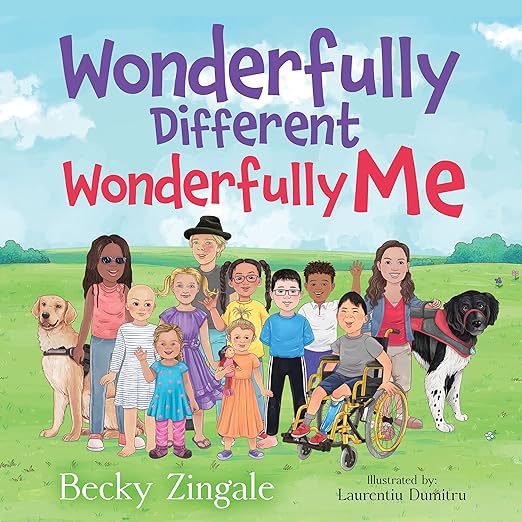
Wonderfully Different, Wonderfully Me features a diverse group of children, celebrates each child’s unique strengths, and promotes inclusion, acceptance and friendship.
Wonderfully Different, Wonderfully Me is the first book written by Becky Zingale. Becky’s husband, Duane, and their younger daughter have the same syndrome as the main character in the book and movie Wonder. Becky wanted to a similar book for a younger audience. She looked for children’s books with pictures of children who have facial differences and wear Bone Anchored Hearing Aids. Unable to find any such books, Becky’s husband Duane, encouraged her to create the solution, by writing children’s books to share the stories of their family and friends. Becky wanted not only her own daughter, but all children, to see themselves in Wonderfully Different, Wonderfully Me whether they connect with a character’s personal challenges, physical appearance, or personality.
If you are a parent, teacher, or medical professional assisting a child who has special needs, or feels a bit different, Wonderfully Different, Wonderfully Me will inspire your child on their journey.
Author: Becky Zingale
Illustrator: Laurentiu Dumitru
Amazon Affiliate link included