
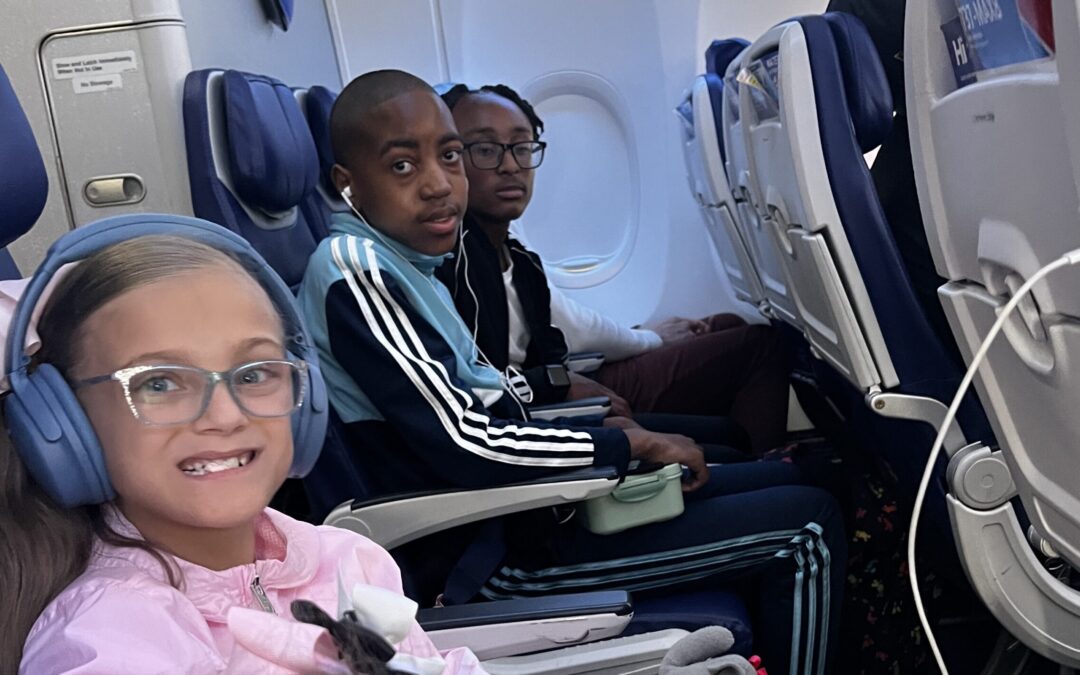
Traveling with a child with special needs can be intimidating for families. There are considerations that many other families may never have to think about: medications, medical equipment, mobility needs, sensory sensitivities, communication challenges, changes in routine, and simply wondering how a child will respond to an unfamiliar environment.
This was the case for our family as we made plans for our summer vacation.
Over the years, because we were unsure about the dynamics involved with special-needs air travel—and, to tell the truth, because we were intimidated—we chose road trips. Driving gave us more control. We could stop when needed, bring the equipment and supplies our children required, and adjust our schedule around their needs.
However, this summer felt different. Our kiddos were a little older, had made progress in their cognitive development, and were healthier than they had been in previous years. We decided it was finally time to take to the skies.
Preparing Before We Ever Reached the Airport
Like with any new venture involving our children, preparation was important. We started by researching the airlines.
Initially, we looked at each airline's recommendations and policies for travelers who required disability-related assistance or other accommodations. We then considered whether the airline could accommodate the specific needs of each of our children and developed an individual plan based on what the airline offered and what each child needed.
This is something I would encourage other families to do. "Special needs" is not one universal category. What helps one child may not help another. A child with sensory sensitivities may need something completely different from a child who uses durable medical equipment (DME), has limited mobility, requires medication, or has difficulty communicating.
We found accommodations and assistance varied somewhat among airlines and airports. Some locations offered access to quieter or more sensory-friendly spaces. With the airlines we used during the summer, we were either directed to a designated area or greeted by personnel after arriving at the airport.
One airline acknowledged that it had already received the information we submitted regarding our family and our children's specific needs. They also made a point of asking whether anything had changed between the time we submitted our information and the day of travel.
With two airlines, staff created an inventory of the medical supplies and DME that we were checking. Much of the process took place away from the normal flow of passengers or in a more private area. That seemingly small accommodation made an enormous difference. We did not feel as rushed, exposed, or overwhelmed.
The service agents we encountered were sensitive to our family's needs. Some gave the children fidgets and plush toys, and noise-canceling headphones were even offered. We had already purchased headphones for the kids, but the gesture still mattered. It demonstrated an awareness that traveling can create sensory challenges for some children.
Once we finished checking in, we expected that we would simply go through the same security process as everyone else.
That was when we learned about another important part of accessible air travel: TSA Cares.
What Is TSA Cares?
TSA Cares is a Transportation Security Administration (TSA) program that provides information and assistance to travelers with disabilities, medical conditions, and other circumstances that may affect security screening. Travelers who want assistance at the security checkpoint are encouraged to contact TSA Cares at least 72 hours before traveling.
Families can also request assistance from a Passenger Support Specialist (PSS). PSS are TSA personnel who have received specialized training to assist travelers who may need additional support during the screening process.
One thing families should understand is that TSA Cares does not eliminate security screening. Rather, the program can help make the required screening process more understandable and manageable for travelers whose disabilities, medical conditions, or individual circumstances may require additional consideration.
The assistance can also look different from airport to airport. At some airports, someone may contact the traveler in advance to gather additional information and establish a meeting location. At others, information may be provided to checkpoint personnel without advance contact. If a Passenger Support Specialist is unavailable, travelers can ask for a Supervisory TSA Officer.
Knowing this beforehand helped us set realistic expectations.
TSA Cares and the Airline Have Different Responsibilities
One of the most important lessons we learned was the difference between the airline's role and TSA's role.
The airline and TSA are separate entities with different responsibilities. TSA is primarily responsible for security screening at the checkpoint. The airline is responsible for services associated with the flight, including check-in, boarding and deplaning assistance, certain seating accommodations, handling assistive devices, and assistance with connections.
For our family, communication with both was important. We wanted the airline to understand our children's needs, but we also wanted TSA Cares to know what might affect the security-screening process.
Families should not assume that requesting assistance from the airline automatically creates a TSA Cares request—or vice versa. Contacting both before the trip can help everyone understand what assistance is needed and where responsibility for that assistance falls.
Medical Supplies and Assistive Devices
Families traveling with medically complex children may also be relieved to know that there are special considerations for medically necessary items.
TSA permits medically necessary liquids, gels, and aerosols in reasonable quantities that can exceed the standard 3.4-ounce liquid limit, although they must be declared to TSA officers and may require additional screening. Medical equipment and supplies may also require separate screening.
Travelers can use a TSA Notification Card or other medical documentation to discreetly communicate a disability, medical condition, or medical device that may affect screening. The card does not exempt anyone from security screening, but it can make communicating sensitive information easier.
Travelers can also request private screening when appropriate.
For families traveling with medications or medical supplies, I would recommend keeping essential items organized and accessible rather than placing everything in checked baggage. The U.S. Department of Transportation also advises passengers to consider carrying medication and assistive devices with them because checked baggage and passengers can sometimes become separated.
Another important protection is that assistive devices generally do not count toward the normal carry-on baggage limit. This can be particularly important for families who already feel as though they are packing half of the house just to meet their child's medical and personal needs.

Know Your Child's Rights
Another resource families should know about is the Airline Passengers with Disabilities Bill of Rights, which summarizes protections provided under the Air Carrier Access Act.
Among other protections, passengers with disabilities have rights related to dignity and respectful treatment, information about available services and aircraft limitations, airport and onboard assistance, assistive devices, certain seating accommodations, and accessible aircraft features.
Passengers with disabilities who self-identify at the gate as needing additional time or assistance to board, stow accessibility equipment, or be seated also have important preboarding protections.
If a family experiences an airline-related disability accommodation problem that cannot be resolved, they can ask to speak with the airline's Complaint Resolution Official (CRO). Airlines are required to make a CRO available during operating hours, either in person or by telephone, to address disability-related concerns.
Knowing your rights does not mean anticipating a conflict. It simply means being prepared to advocate effectively if something does not go according to plan.
What We Learned
Perhaps the biggest lesson from our summer travels was that preparation gave us confidence.
Before our first flight, we were worried about everything that could go wrong. By the end of the summer, we had learned that air travel with children who have special needs does not have to be impossible. It requires planning, communication, flexibility, and sometimes a little extra patience.
For our family, nonstop flights were the best option. Every connection creates another transition: another airport, another gate, another boarding process, and potentially another opportunity for sensory overload, fatigue, equipment issues, or delays. When we had the option, reducing those transitions made traveling easier for everyone.
I would also encourage families to create a simple travel plan before leaving home. Write down each child's needs, medications, medical equipment, sensory triggers, communication needs, and the accommodations you requested. Keep airline and TSA information accessible on your phone. Take photographs of important DME before checking it, and consider carrying written instructions for specialized equipment.
Most importantly, give yourself and your child some grace. A successful trip does not have to look like another family's trip.
Looking back, we appreciate programs such as TSA Cares because they helped make something that once felt intimidating more manageable. Travel gives our children opportunities to experience new places, people, environments, and activities. Those experiences are part of inclusion, independence, family connection, and quality of life.
For years, uncertainty kept our family on the road.
This summer, preparation helped us take to the skies.
And we are glad we did.
Before You Fly: A Special-Needs Family Travel Checklist
- Contact TSA Cares at least 72 hours before travel when checkpoint assistance is needed.
- Request a Passenger Support Specialist if your child may benefit from additional assistance during security screening.
- Contact the airline's accessibility or disability-assistance department separately.
- Explain your child's individual mobility, medical, sensory, behavioral, and communication needs.
- Ask about preboarding and any seating accommodations your child may require.
- Ask whether your airport has a sensory-friendly or quieter space.
- Download or print a TSA Notification Card if discreet communication about your child's condition would be helpful.
- Keep essential medications and medical supplies in your carry-on whenever possible.
- Organize medically necessary liquids so they can be easily identified during screening.
- Photograph DME, wheelchairs, mobility devices, and other important equipment before checking or gate-checking them.
- Carry written instructions for specialized medical or mobility equipment.
- Pack sensory supports such as noise-canceling headphones, fidgets, comfort objects, or familiar activities.
- Keep confirmation numbers and airline and TSA contact information easily accessible.
- Build additional time into your airport schedule.
- Consider a nonstop flight when feasible to reduce transitions.
- Know that you can ask for the airline's Complaint Resolution Official (CRO) if an airline disability-accommodation issue cannot be resolved.
Written by Sheila Williams